












































































certification
Non-flammable DTF transfer and heat-resistant: our IFTH tests
ISO 15025 & ISO 17493

Sherpa Transfert had several of its textile marking solutions tested by IFTH, the French Institute for Textiles and Clothing.
The objective was to measure the behavior of a multi-risk textile personalized with our transfers when exposed to flame and high heat.
Tests were conducted using two international methods:
- ISO 15025, method A, for limited flame propagation;
- ISO 17493 for material heat resistance.
The tested assemblies achieved conclusive results under the specific conditions of the test report.
These results allow workwear professionals, textile personalization specialists, and protective equipment manufacturers to have reliable technical information before launching a marking project.
Definition
What does a non-flammable DTF transfer mean?
The term "flame-resistant DTF transfer" must be used with precision.
In the field of protective clothing, performance does not depend solely on the transfer. It depends on the complete system composed of:
- the fabric;
- the textile transfer;
- application conditions;
- the marked surface;
- garment construction;
- its care;
- its final use.
A transfer tested on a multi-risk fabric does not automatically make all personalized garments compliant with a standard.
The results obtained by Sherpa Transfert concern the fabric + marking combination presented during testing.
OUR TRANSFERS
Which transfers have been tested?
Tests were conducted on several marking solutions offered by Sherpa Transfert:
- DTF PRO transfer;
- DTF PRO MAX transfer;
- DTF Softshell BLOCKMAX transfer;
- monochrome screen printing transfer.
Testing was performed after five wash cycles to evaluate the behavior of the markings after care.
The substrate used was a multi-risk textile made of technical fibers suitable for the manufacture of protective clothing.

Flame protection test according to ISO 15025
ISO 15025 standard defines methods for evaluating limited flame propagation on textile materials.
Method A consists of applying a flame to the surface of the tested material for a defined duration, then observing its behavior.
During tests performed on textile + Sherpa Transfert transfer assemblies, the observations reported were as follows:
- no flame propagation;
- no melting of the print;
- no debris fall;
- no formation of flaming droplets.
These results concern exclusively the assemblies, parameters, and conditions described in the test report.
Heat resistance test according to ISO 17493
The ISO 17493 method makes it possible to evaluate the behavior of materials that make up protective clothing when exposed to high temperature.
The textile + transfer assemblies tested by Sherpa Transfert were exposed to a temperature of 180 °C.
Under test conditions:
- no transfer caught fire;
- no significant degradation of the marking was observed;
- the transfer remained bonded to the tested substrate.
These results provide important information for textile customization projects intended for heat-exposed environments.
Can we talk about fire-resistant certification?
It is more accurate to speak of flame and heat behavior tests conducted by IFTH.
Test reports document the behavior of tested assemblies. They do not constitute a universal certification of all Sherpa Transfert transfers on all garments.
The compliance of a customized personal protective garment must be evaluated on the final product.
A change in textile, transfer, marking size, application temperature or positioning may alter the performance of the assembly.
Is a marked garment automatically certified?
No.
Personalizing a non-fire-resistant garment can alter its initial behavior. The finished product must therefore be studied as a new assembly.
Using a transfer that has achieved good results in a trial provides an interesting technical basis. However, it does not automatically confirm that the marked garment is certified or compliant.
To obtain official validation of your own product, you must have the complete assembly tested, including in particular:
- the exact garment reference;
- the transfer used;
- the logo size;
- its placement;
- the application parameters;
- any accessories;
- the planned number of washes.
These tests can be carried out by a specialized laboratory such as IFTH.
Why is marking a protective garment sensitive?
A protective garment is designed to address specific risks.
Adding a textile marking can locally modify certain characteristics:
- flame reaction;
- heat transfer;
- breathability;
- flexibility;
- mechanical resistance;
- visibility of certain areas;
- performance of reflective bands.
The choice of transfer must therefore be integrated from the design stage of the garment or customization project.
A logo that is too large, poorly positioned, or applied with unsuitable parameters can have a different impact than a small marking placed on a secondary area.
Which professionals are these samples for?
This information is primarily intended for professionals working on technical clothing or equipment for high-risk environments:
- professional clothing manufacturers;
- personal protective equipment specialists;
- PPE professionals;
- textile marking workshops;
- workwear distributors;
- equipment manufacturers;
- industrial companies;
- construction professionals;
- maintenance companies;
- security services;
- public organizations;
- transport companies;
- technical services.
They can also be useful for agencies and brands that must comply with specific requirements for personalizing professional clothing.
Our transfers
Which marking method to choose for workwear?
The choice depends on the textile, its use, and project constraints.
DTF transfer
DTF transfer allows you to reproduce logos in full color, gradients, and fine details.
It is suitable for many textile personalization projects. For protective clothing, its use must however be validated on the final substrate.
Screen print transfer
Screen-printed transfer is particularly suited for monochrome logos.
It offers precise rendering, good opacity, and excellent consistency for series production.
The BLOCKMAX Softshell DTF transfer
The BLOCKMAX DTF Softshell transfer is designed for softshell textiles with a risk of pigment migration.
Its main role is to limit color bleeding into the marking. This anti-migration function does not, by itself, constitute a fire-safety certification.
Steps
How to prepare a marking project on non-flame textile?
Before any production, several elements must be validated.
Identify the textile precisely
Composition alone is not enough. Two fabrics with similar composition can have different treatments, structures, and performance.
Therefore, you must know the exact reference of the garment or fabric.
Set the Marking
The size, shape, thickness and placement of the transfer can influence the result.
It is best to define the final marking before conducting tests.
Comply with application conditions
Temperature, duration, and pressure must match the transfer recommendations and the textile's limits.
A technical textile can be sensitive to excessive heat or pressure.
Carry out preliminary tests
An application test allows you to verify:
- adhesion;
- visual appearance;
- compatibility with the substrate;
- absence of deterioration;
- durability after washing.
For a regulated project, this internal test does not replace testing performed by a competent laboratory.
Have the final product validated
When compliance of the personalized garment is mandatory, the finished garment must be tested in its actual configuration.

French manufacturers
French expertise in professional textile transfer

Sherpa Transfert is the leading French DTF transfer and custom patch provider.
Pioneers of online DTF printing in France, we support textile personalization professionals in their standard projects as well as their most technical requests.
Our transfers are printed in our workshop in Moirans, Isère, near Grenoble.
Our production facility, equipped with over 50 print heads, allows us to handle small runs as well as large productions with short and guaranteed lead times.
Patches with short lead times
Additional expertise in custom patches
Sherpa Transfert is also the leader in custom patches in France, particularly for small quantities and short lead times.
We manufacture several patch families:
- sublimation-printed patches;
- 3D embossed patches;
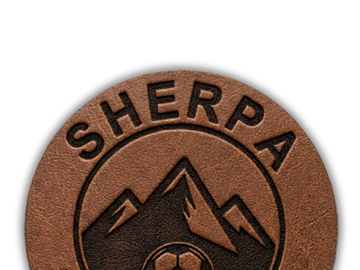
- engraved patches;
- heat-seal patches;
- velcro patches;
- sew-on patches.
For technical garments, the choice between textile transfer and patch should be made based on use, material, stress level, and specification requirements.
As with any marking, adding a patch to a protective garment must be subject to appropriate validation.


FAQ on non-flammable DTF transfers
Is there a non-flammable DTF transfer?
Some DTF transfers can achieve good results when tested on a specific non-flame textile. However, the textile + transfer combination must be evaluated, not the transfer alone.
Are Sherpa Transfert DTF transfers fire-certified?
Assemblies containing certain Sherpa Transfert transfers have been tested by IFTH according to ISO 15025 and ISO 17493 methods.
These results do not constitute automatic certification of all garments customized with our transfers.
What is ISO 15025 standard?
ISO 15025 standard describes test methods for measuring limited flame spread on textile materials.
What is ISO 17493 standard?
The ISO 17493 standard allows you to evaluate the heat resistance of materials and assemblies used in protective clothing.
At what temperature were the transfers tested?
The assemblies in question were exposed to a temperature of 180 °C as part of the heat resistance test.
Were tests performed after washing?
Yes. The transfers mentioned in the report were tested after five wash cycles.
Can a tested transfer be applied to any PPE?
No. Each garment reference, each transfer and each marking configuration can produce a different result.
Does the transfer make a standard garment flame-resistant?
No. A non-flame transfer does not transform a standard garment into protective clothing against heat or flames.
Can I claim that my personalized garment is certified?
Only if you have an official document that precisely covers the final garment, textile, marking and configuration used.
How to get a personalized garment certified?
You must submit a representative sample of the final garment to a competent laboratory. It will determine the necessary tests according to use and claimed standards.
Can you personalize a multi-risk garment with DTF?
Yes, provided the textile is compatible with application and the final product meets project requirements. For regulated use, laboratory validation is necessary.
Where are Sherpa Transfert transfers manufactured?
Our transfers are manufactured in France in our workshop in Moirans, Isère, near Grenoble.


