







































What is 8-color DTF printing?
Complete guide: difference between 8-color DTF and standard DTF (CMYK) — gamut, grain, blacks and color accuracy.
- ✔ Deeper blacks
- ✔ Better resolution
- ✔ Brighter colors
- ✔ Wider spectrum
- ✔ Finer grains

8-color DTF: beyond standard CMYK DTF

DEFINITION
What is 8-color DTF printing?
The 8-color DTF is the evolution of standard DTF printed in CMYK (4 colors).
The difference lies in print quality and color management.
Most DTF prints work with a CMYK color spectrum (Cyan, Magenta, Yellow, Black).
👉 The 8-color DTF, thanks to its expanded gamut (RGB / 8 inks), can access colors outside this usual range.
This allows it to reproduce certain brighter, more intense or saturated hues that are normally impossible to achieve with a standard DTF transfer.
Print quality is also significantly better, with greatly reduced grain and deeper blacks.
features
Concretely, what does it change?
👌 Best print quality
The grain is particularly fine. Solid colors are more uniform and small details stand out with greater precision.
🎨 Extended color spectrum
8-color DTF reproduces more colors than a standard CMYK DTF transfer. This allows you to get closer to the visual created on screen.
🌈 Access to more vibrant colors
Accessible colors are more numerous and therefore brighter and richer. Greens are more intense, blacks deeper, and gradients more natural.
🔎 More faithful reproduction of designs
Logos, illustrations and photographs better retain their original colors and shades.
☁️ Comfort and flexibility
Despite its high performance level, the transfer retains the flexibility and comfort that make DTF successful.
⚡ From 1 piece with fast turnaround
Order with no minimum and quickly!
This allows you to order small runs, prototypes or quick reorders.
Analytics
Comparison between standard DTF and 8-color DTF


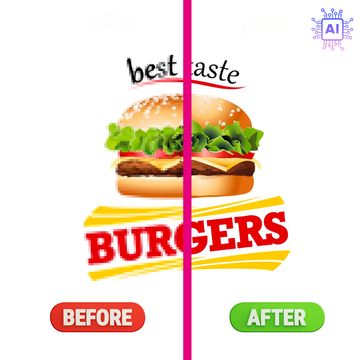
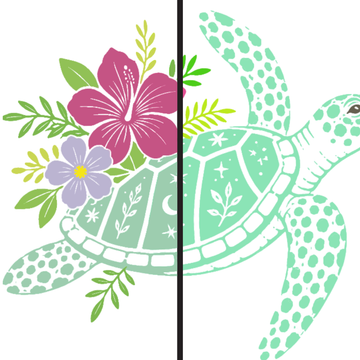
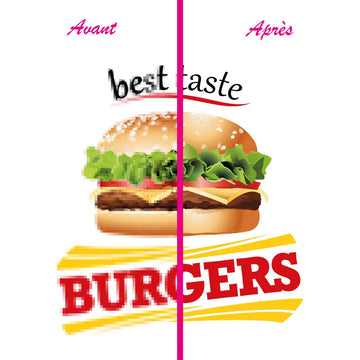
Comparison between a standard Sherpa Transfert DTF "DTF PRO" and an 8-color Sherpa Transfert DTF transfer "DTF PRO MAX".


Comparison between a standard Sherpa Transfert DTF "DTF PRO" and an 8-color Sherpa Transfert DTF transfer "DTF PRO MAX".


Decryption
We explain everything
A wider gamut for more accurate colors
Why do we talk about extended spectrum and more vibrant colors?
To properly understand the 8-color DTF, you need to go back to the concept of color spectrum.
👉 A color spectrum (or gamut) represents all the colors that a printer, screen or printing process is capable of reproducing.
A screen displays colors in a very wide space. This is why a visual can appear very vibrant on a computer. However, not all printing technologies can reproduce exactly this level of intensity.
The vast majority of DTF prints use a gamut based on CMYK (Cyan, Magenta, Yellow, Black), which limits reproducible colors to those within this standard printing spectrum.
When a color falls outside the CMYK gamut, a standard DTF transfer is forced to replace it with the closest available color.
This adaptation often results in a loss of intensity or a slight modification of the original hue.
Thanks to its expanded color spectrum (8 colors / RGB), 8-color DTF can reproduce more colors and therefore better faithfulness to your logo.
The result is a rendering closer to the original file. The difference is particularly visible on certain shades of blue, green, orange or on visuals with very dynamic colors.
👉 Important: the 8-color DTF does not artificially modify colors, it reproduces more faithfully certain colors outside CMYK.
The gain therefore does not come from over-saturation, but from access to a larger number of colors.
👉 If your logo contains only colors already present in the CMYK spectrum, the rendering will be very similar between a standard DTF and an 8-color DTF.

Higher print resolution
Why is print quality better?
Print quality depends notably on the fineness of ink droplets, their placement and their management.
The 8-color DTF uses optimized settings to achieve extremely fine grain. Color transitions are smoother, gradients more fluid and details more precise. Solid areas are also more uniform.
Small text, complex elements, outlines or detailed patterns gain in sharpness. The rendering is cleaner, more precise and more faithful to the original file.
Outlines also appear sharper, which improves the overall perception of marking quality.
More uniform solid colors
Why are solids better managed?
One of the advantages of the 8-color DTF concerns solid color areas.
Since more intermediate shades are available, transitions are smoother and uniform color zones appear more homogeneous.
Solid areas show fewer visual variations and the overall result gains in perceived quality.
This difference is particularly noticeable on large printed surfaces.

As close as your screen
Why is the reproduction more faithful?
Color fidelity is the ability to reproduce a printed visual as close as possible to the original file.
Thanks to its extended color space and color profile, the 8-color DTF is capable of preserving more nuances and subtleties present in the source file.
Brands with demanding graphic standards particularly appreciate this consistency and printing reliability.
8-color DTF has its limits
What are the limitations of 8-color DTF?
8-color DTF significantly improves visual rendering, but it does not completely transform the constraints of textile printing.
Like any DTF transfer, it remains subject to the physical limitations of textiles and inks. Some extremely fluorescent or metallic colors still require specific technologies.
The difference is also more visible on visuals rich in colors than on simple monochrome logos.
8-color DTF does not necessarily provide a major advantage on basic markings.
👉 If your file does not contain colors outside the CMYK spectrum, there is no need to order 8-color DTF! A standard DTF transfer will perfectly reproduce the colors of your design.
However, print quality (grain) will remain better with 8-color DTF.
THE TEXTILE TRANSFER THAT GOES BEYOND CMYK LIMITS
Gamut: explanation
The gamut is the color space that a machine is capable of reproducing. In other words, it represents the set of colors that a printer can print with precision.
Each printing technology has its own limitations. A standard DTF print generally works with a gamut based on CMYK (Cyan, Magenta, Yellow, Black). Certain very bright, vivid or saturated colors visible on a screen therefore cannot be reproduced faithfully in print.
Our new technology uses an expanded RGB type gamut, capable of reproducing a much wider palette of colors. It makes it possible to achieve hues that fall outside the spectrum usually accessible in CMYK, notably certain electric blues, intense greens, brilliant reds or very vivid oranges.
Concretely, the wider the gamut, the more colors the printer has at its disposal. The result is a print more faithful to the original visual, with richer, deeper and more vibrant colors when the file actually contains these hues.
👉 Perfect for colorful logos, illustrations, complex gradients and all visuals where color accuracy is essential.

Comparison of DTF color gamuts
Human Eye
It represents all colors visible to the human eye. It is the largest color space.
DTF PRO MAX
Its extended gamut allows reproduction of more intense and saturated colors. It is particularly effective on greens, blues, oranges, and certain shades that are difficult to achieve in standard printing.
DTF PRO
It offers an intermediate color space. It allows faithful reproduction of most colors present in print files.
DTF Standard
Its gamut is more limited. Some very bright colors or those outside the CMYK spectrum may be less well reproduced.
Key takeaway: the larger the represented area, the more the technology can render a wide variety of colors.


the choice
DTF 8 colors (RGB) or standard DTF (CMYK): which one to choose?
The standard DTF (CMYK) remains an excellent solution for most textile customization projects. It already offers a very good quality level, great versatility, and excellent value for money.
8-color DTF is designed for professionals who want to go further. It delivers better print quality, a wider color gamut, more vibrant colors, finer grain, and superior color accuracy.
If your priority is to achieve the best possible visual result, 8-color DTF is currently the most high-performing solution.
👉 If your file does not contain colors outside the CMYK spectrum, there is no need to order 8-color DTF! A standard DTF transfer will perfectly reproduce the colors of your design.
How to know if your file can benefit from DTF 8 colors?
The best way to find out is to check whether certain colors in your file fall outside the CMYK spectrum.
This is often the case with very bright colors, close to neon, certain greens, oranges, pinks, blues or highly saturated purples.
These shades can be difficult or even impossible to reproduce faithfully with standard DTF printing.
To help you, our online tool analyzes your file and identifies whether certain colors fall outside the CMYK spectrum.
If so, 8-color DTF is the best choice to get a transfer closer to the expected on-screen result.


Why use 8-color DTF?
The 8-color DTF is particularly recommended for:
- Textile brands.
- Premium collections.
- High-end personalized clothing.
- Color-rich logos.
- Photographic visuals.
- Complex gradients.
- Projects where visual impact is essential.
It delivers the best possible result while retaining the advantages of DTF transfer: order from a single piece, great textile compatibility, flexibility and ease of application.


8-color DTF (RGB) vs standard DTF (CMYK)
| Standard DTF (CMYK) | DTF 8 colors (RGB) | |
|---|---|---|
|
Colors
|
CMYK gamut |
RGB Gamut |
|
Coverage
|
Excellent |
Excellent |
|
Minimum fineness
|
0.5 mm |
0.5 mm |
|
Print rendering
|
High resolution | Low grain |
Exceptional | Very Low Grain |
|
Format
|
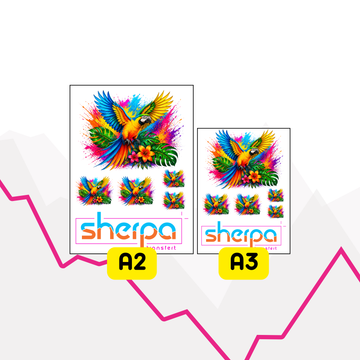
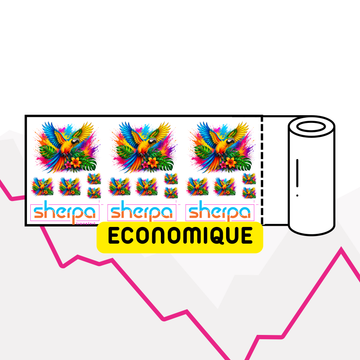
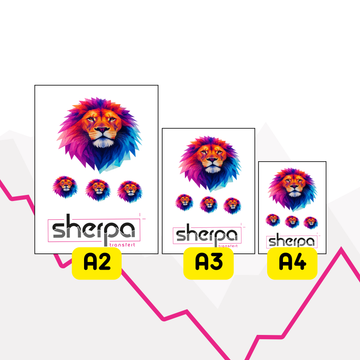
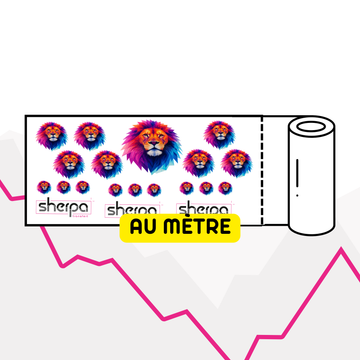
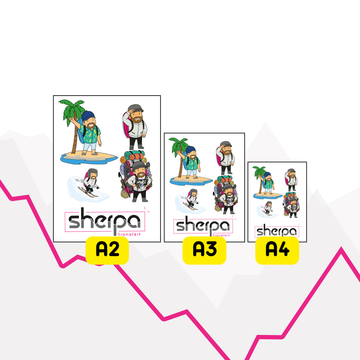
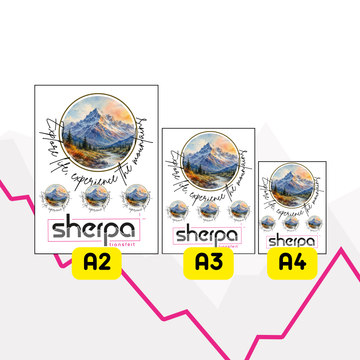
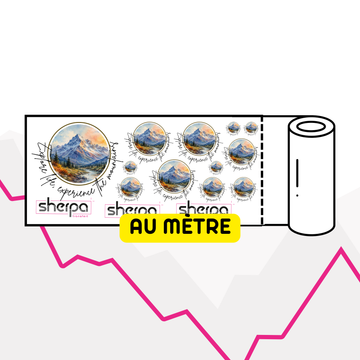
CUSTOM LOGO | METER | A2 | A3 | A4 |
BY LOGO | METER | A2 | A3 |
|
Lead Times
|
D0 | D+1 | D+2 | D+5 |
D0 | D+1 | D+2 | D+5 |
|
Additional services
|
Reproducibility | Proof | Acceleration | Email Order |
Reproducibility | Proof | Acceleration | Email Order |
|
Profiles / supports
|
Unique |
White, black or mixed |
|
Logo cut
|
Yes (optional with Easy Order) |
Yes (optional with Easy Order) |
|
Ordering method
|
Fast order | Easy order |
Fast order | Easy order |
|
Finishing method
|
Cut by sheet or by logo |
Cut by sheet or by logo |
The Essentials
What you need to know about 8-color DTF
The 8-color DTF is an evolution of standard DTF (CMYK).
It allows you to:
- Significantly reduce print grain
- Reproduce more vibrant colors (outside CMYK gamut)
- Expand color rendering range
- Better respect rich and saturated visuals
- Achieve more subtle gradients
- Obtain deeper blacks
- Order from 1 unit
For professionals who want to take textile transfer further, it's a high value-added solution when color becomes a real differentiator.
👉 If your file does not contain colors outside the CMYK spectrum, there's no need to order an 8-color DTF! A standard DTF transfer will perfectly reproduce the colors of your design.
Useful resources
Quick links to access important information.
File guide
Tips for exporting your PDF/AI/PNG.
AI tools
Automatic vectorization and background removal are at your disposal.
Tutorials and articles
Expert guides, tutorials, compatibility information and blog to help you in any situation.
Design service
Our teams support you at every step.
FAQ – 8-color DTF vs standard DTF
What is 8-color DTF?
8-color DTF is high-quality DTF printing that uses 8 inks (RGB+) instead of the 4 CMYK colors of standard DTF. It offers an expanded color gamut, finer grain, and deeper blacks, for more accurate and impactful textile markings.
What is the difference between 8-color DTF and standard DTF (CMYK)?
Standard DTF prints in 4 CMYK colors. 8-color DTF prints in 8 RGB+ colors: better resolution, expanded color gamut, more precise gradients, and much finer grain. The result is closer to the original file.
👉 If your file doesn't exceed the CMYK spectrum, standard DTF is sufficient. Test your file.
Why choose 8-color DTF?
8-color DTF is ideal when you're looking for the best textile print quality: richer colors, precise details, faithful reproduction of logos, illustrations and photographs.
Are the colors really more vibrant?
Yes, when your file contains colors outside the CMYK gamut. Thanks to its expanded spectrum, 8-color DTF reproduces more intense and brighter colors — especially on bright colors, gradients and complex visuals.
What is an extended color spectrum?
The spectrum (or gamut) corresponds to all the colors that a printing technology can reproduce. With its RGB gamut / 8 colors, 8-color DTF covers more shades than standard CMYK DTF printing, which improves the richness and accuracy of your designs.
Why is the print quality of 8-color DTF better?
The 8-color DTF uses advanced print settings and higher resolution, which greatly reduces grain. Details are sharper, outlines more precise, and solid colors more uniform.
Can gradients be printed with 8-color DTF?
Yes. 8-color DTF perfectly reproduces gradients, shadows, complex visual effects, and photographs thanks to its high printing precision.
Is 8-color DTF resistant to washing?
Yes. Like standard DTF, 8-color DTF offers excellent durability over time when applied according to application recommendations. See application conditions.
Which textiles are compatible with 8-color DTF?
The 8-color DTF is compatible with cotton, polyester, cotton-polyester blends, softshells and the majority of textiles used in customization. Find out about materials.
Can you order 8-color DTF from 1 piece?
Yes. 8-color DTF printing is available with no minimum order, for a prototype, small series or larger production.
Does 8-color DTF replace standard DTF?
No. Standard DTF (CMYK) remains excellent for most projects, especially in volume or advertising. 8-color DTF is aimed at professionals who want the best possible visual rendering — out-of-CMYK colors, clean solids, dense blacks.


